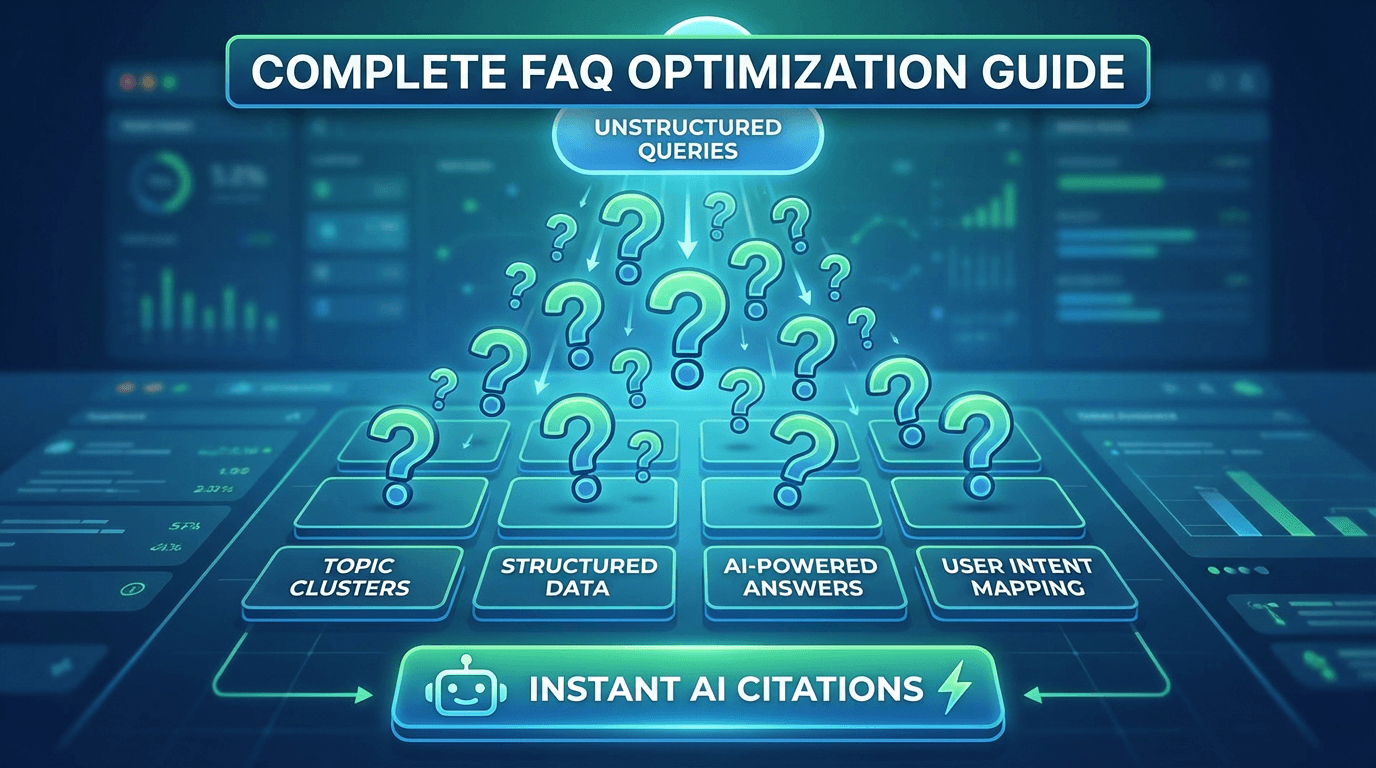
The Complete FAQ Optimization Guide for AI Search
Master the art of FAQ optimization for AI search engines. Learn how to structure questions, write answers that get cited, and implement FAQ schema for maximum visibility.
Key Takeaways
- FAQs are the most important content format for AI search visibility
- Ideal FAQ answers are 40-80 words and lead with a direct response
- Every FAQ section must have corresponding FAQPage schema markup
- Add FAQs to dedicated pages, service pages, blog posts, and your homepage
- Avoid duplicate FAQs across pages—each page needs unique, relevant questions
Why FAQs Are Critical for AI Search
Last updated: January 2026FAQs are the single most important content format for AI search visibility. When users ask ChatGPT, Claude, or Perplexity questions, these systems actively seek out question-answer formatted content to cite.
The data is clear:- Pages with FAQ schema are 3x more likely to be cited by AI systems
- Question-based headers increase AI extraction accuracy by 65%
- Well-structured FAQs improve GEO scores by an average of 23 points
If you're serious about AI search visibility, FAQ optimization should be your top priority.
The Anatomy of an AI-Optimized FAQ
Question Format
Do:- Use natural, conversational language
- Start with question words (What, How, Why, When, Where, Who)
- Match how real users ask questions
- Include your target keywords naturally
- Use jargon or technical terms in questions
- Make questions too long or complex
- Use questions as keyword-stuffing opportunities
Answer Format
The ideal FAQ answer follows this structure:
- Direct answer first (1-2 sentences)
- Supporting detail (2-3 sentences)
- Practical takeaway (1 sentence)
Why This Structure Works
AI systems are designed to extract concise, authoritative answers. When you:
- Lead with the direct answer, AI can cite you accurately
- Provide supporting detail, you demonstrate expertise
- End with a takeaway, you provide actionable value
Where to Add FAQs
1. Dedicated FAQ Page
Create a comprehensive FAQ page covering all common questions about your business, products, or services.2. Service/Product Pages
Add 3-5 relevant FAQs to each service or product page addressing specific questions about that offering.3. Blog Posts
Include an FAQ section at the end of blog posts addressing questions the post may have raised.4. Homepage
Add a brief FAQ section addressing the most common visitor questions.5. About Page
Include FAQs about your company, team, and processes.FAQ Schema Implementation
Every FAQ section needs corresponding FAQPage schema:
{
  "@context": "https://schema.org",
  "@type": "FAQPage",
  "mainEntity": [
    {
      "@type": "Question",
      "name": "Your question here?",
      "acceptedAnswer": {
        "@type": "Answer",
        "text": "Your answer here."
      }
    }
  ]
}
Finding the Right Questions
Method 1: Search Console Queries
Look at what questions people are already searching to find your site.Method 2: Customer Support Analysis
Review support tickets and chat logs for common questions.Method 3: AI Tool Research
Ask ChatGPT and Perplexity questions about your topic and see what related questions they suggest.Method 4: Competitor Analysis
Review competitor FAQ pages for questions you should also answer.Method 5: People Also Ask
Check Google's "People Also Ask" boxes for your target keywords.Common FAQ Mistakes
Mistake 1: Answers That Don't Answer
Many FAQs avoid giving direct answers. AI systems skip these. Bad: "Pricing depends on many factors. Contact us for a quote." Good: "Our $99 DIY audit report includes step-by-step fix instructions. Done-for-you services range from $2,997 to $9,997 depending on scope. Most clients invest $2,997-$5,997. Contact us for a custom quote."Mistake 2: Too Short
One-sentence answers don't demonstrate expertise.Mistake 3: Too Long
Multi-paragraph answers are hard for AI to extract. Keep answers under 100 words.Mistake 4: Duplicate Questions
Having the same question answered on multiple pages creates confusion. Each page should have unique FAQs relevant to that page's content.Mistake 5: No Schema
FAQs without schema markup lose 50%+ of their AI citation potential.FAQ Optimization Checklist
Use this checklist for every FAQ section:
- Questions use natural, conversational language
- Each answer starts with a direct response
- Answers are 40-80 words
- FAQPage schema is implemented
- Schema matches visible page content
- Questions are unique across your site
- FAQs are relevant to the page topic
- Target keywords appear naturally
- Answers provide specific, actionable information
- No jargon without explanation
Measuring FAQ Performance
Track these metrics to measure FAQ effectiveness:
- GEO Score improvement - Run audits before and after optimization
- AI citations - Manually test if AI tools cite your FAQs
- Rich results - Check if Google shows FAQ rich snippets
- Page engagement - Monitor time on page and scroll depth
- Conversion impact - Track if FAQ pages influence conversions
Advanced FAQ Strategies
Nested FAQs
For complex topics, use nested FAQ structures with category headers.Dynamic FAQs
Use user behavior to surface the most relevant FAQs based on visitor segment.Video FAQs
Supplement text FAQs with video answers for key questions.Comparison FAQs
Create FAQs that compare your solution to alternatives—AI systems love comparison content.Frequently Asked Questions
How many FAQs should I have per page?
For dedicated FAQ pages, aim for 15-25 comprehensive questions. For service or product pages, 3-5 highly relevant FAQs is ideal. For blog posts, 3-5 questions that the post may have raised works well. Quality and relevance matter more than quantity.
Should I duplicate FAQs across multiple pages?
No, avoid duplicating FAQs. Each page should have unique FAQs relevant to that specific page's content. If a question applies to multiple pages, choose the most relevant page or rephrase the question to be page-specific.
Do FAQs help traditional SEO as well?
Yes, optimized FAQs with proper schema benefit both traditional SEO and GEO. Google can display FAQ rich snippets in search results, increasing click-through rates. The question-answer format also naturally incorporates long-tail keywords.
How often should I update my FAQs?
Review and update FAQs quarterly, or whenever your products, services, or policies change. Add new FAQs when you notice new common questions from customers. Update answers to reflect current information and pricing.
Topics
Ready to Optimize Your Site for AI Search?
Get a free GEO audit and see your optimization score in 90 seconds.
Start Free Audit